 Our experienced tutors who are practising solicitors who are senior members of the profession are ready to help you pass your SQE and kick start your legal careers.
Need information ?
Email info (at) britishlawacademy (dot) com
Learn Legal English and Common Law

Our experienced tutors who are practising solicitors who are senior members of the profession are ready to help you pass your SQE and kick start your legal careers.
Need information ?
Email info (at) britishlawacademy (dot) com

The new SQE 1 structure will apply to all sitters from the January 2027 onwards. This includes resitters.
What main changes is the SRA introducing?
Reducing the number of questions
Each Functioning Legal Knowledge (FLK) assessment will be reduced from 180 to 170 questions.
As each FLK continues to be divided into two sessions per day, and candidates will now answer 85 questions per session, instead of 90 per session.
Thus, the total number of questions candidates answer in SQE1 overall will be 340, rather than 360.
2. To whom do these changes apply?
To candidates sitting in January 2027 and re-sitters.
3. What is the time allowed?
The time allowed remains unchanged at 2 hours 33 minutes per session. This means candidates will have slightly more time per question.
4. How will questions be grouped?
Another change is that subjects will now be grouped into specific sessions.
Questions in all subject areas will no longer be presented in both sessions of an FLK assessment. The questions in each FLK session will contain questions from the subject areas as shown in the table below:
FLK Session Subjects
FLK 1
Session 1
Session 2
FLK 2
Session 1
Session 2
NB: Ethics and Professional Conduct will however continue to be tested across all subject areas and can therefore be tested in each session.
Randomisation. Within each session, questions will continue to be fully randomised between those subject areas (i.e. candidates will not have all of the questions on one subject area presented together before the questions on another subject area are presented). This means that candidates will not receive questions grouped by subject areas; instead, questions covering the session’s different subject areas will appear in a mixed, random order throughout the sessions.
Reducing the number of questions
The SRA has made changes having listened carefully to candidate and stakeholder feedback. In particular, some candidates have told the SRA that the SQE1 assessment can feel rushed and pressurised in terms of the amount of time allowed to answer a question, and this can be exacerbated by the lack of some grouping of questions in the sessions.
The number of questions originally used in SQE1 assessments was carefully considered when developing the SQE. This recognised the need to sample all the subject areas in each FLK and have an assessment that was reliable. This means the assessment is consistently fair and accurate and a candidate’s score is a good and highly reproducible reflection of their ability.
The SRA is reducing the number of questions in SQE1 now following a data review from all previous SQE1 assessment windows. Making this change now, rather than after only a small number of deliveries, allows the SRA to review a sufficient amount of assessment data to provide confidence that reducing the number of questions will both improve the candidate experience and retain the accuracy of the assessment.
Grouping questions by session
For SQE1 assessments taken so far, all subject areas were assessed in both sessions of an FLK assessment. Some candidates have told the SRA that this has made it more challenging than it would otherwise have been. Dividing the subject areas for each FLK between the two sessions will allow candidates to focus on fewer subjects in each session. Retaining randomisation of questions within each session will help to preserve assessment security requirements.
The changes will first apply for the January 2027 SQE1. These will apply to all candidates – both first sitters and re-sitters.
Time allowed. Candidates will still be allowed 2 hours 33 minutes per session.
Blueprint. The proportion of questions that can be asked in each subject area (i.e. the SQE1 assessment blueprint) remains unaffected.


How to Become a Successful International Lawyer
What does it take to build a successful career across borders?
Join our upcoming webinar and explore the essential skills, knowledge and mindset needed to succeed as an international lawyer in today’s global legal environment.
We will discuss:
Whether you are a law student, trainee, newly qualified lawyer or experienced legal professional looking to expand your international horizons, this webinar will offer practical insights and inspiration for your career journey.
Date: 2 October 2026
Time: 13:00-14:00 CET (Rome Time)
Online: Zoom
Registration Essential – Registration Form: How to become a successful international lawyer
Take your legal career beyond borders. Join us and discover how to become a successful international lawyer!
#InternationalLaw #InternationalLawyer #LegalCareer #LegalEnglish #Lawyers #CareerDevelopment #ProfessionalDevelopment #GlobalLaw #ComparativeLaw #LegalEducation #Webinar


The concept of subjective culture comes from Dr. Harry Triandis, a cross cultural psychologist, viewed culture as objective (also known as material) and subjective.
Subjective culture comprises ideas, attitudes and beliefs. An inter-culturist would focus primarily on subjective culture.
Material culture is man-made such as clothes and tools. On the other hand, subjective culture is the intangible part of culture such as ideas, attitudes, assumptions and beliefs. In other words, it is “a society’s characteristic way of perceiving its social environment”.
We can subdivide these further by taking either an ‘etic‘ or ‘emic‘ approach to studying the subjective elements.
“Etic” refers to the general categories. These elements can be found in all cultures and which we use to make comparisons.
“Emic” refers to elements which are specific to a given culture. This makes cultures unique.
Cultures have their own unique mix of beliefs, attitudes, norms and values.


 The British Law Academy (BLA) is excited to announce the launch of our services in Germany.
Our mission is simple: to support German legal professionals working across civil and common law jurisdictions by providing high-quality law courses and specialised Legal English training.
As cross-border work continues to grow, many German practitioners are engaging with lawyers from common law countries, such as England and Wales and Australia more frequently.. Understanding not just the language, but the legal concepts, structures, and culture behind it, is essential for German lawyers and their clients.
At the British Law Academy, our professional trainers who are also practising solicitors in England and Wales and Australia, will train you in:
• Practical law courses focused on key areas of common law
• Tailored Legal English programmes for lawyers and legal professionals
• Skills-based training designed for real-world international practice such as pre-trial negotiations, mediation, and litigation.
Whether you’re collaborating on international transactions, disputes, or advisory work, our courses run by expert lawyers with practical experience, are designed to give you clarity, confidence, and precision in your legal communication.
Join us today as we build a bridge between common law and civil law legal systems.
PRESS RELEASE
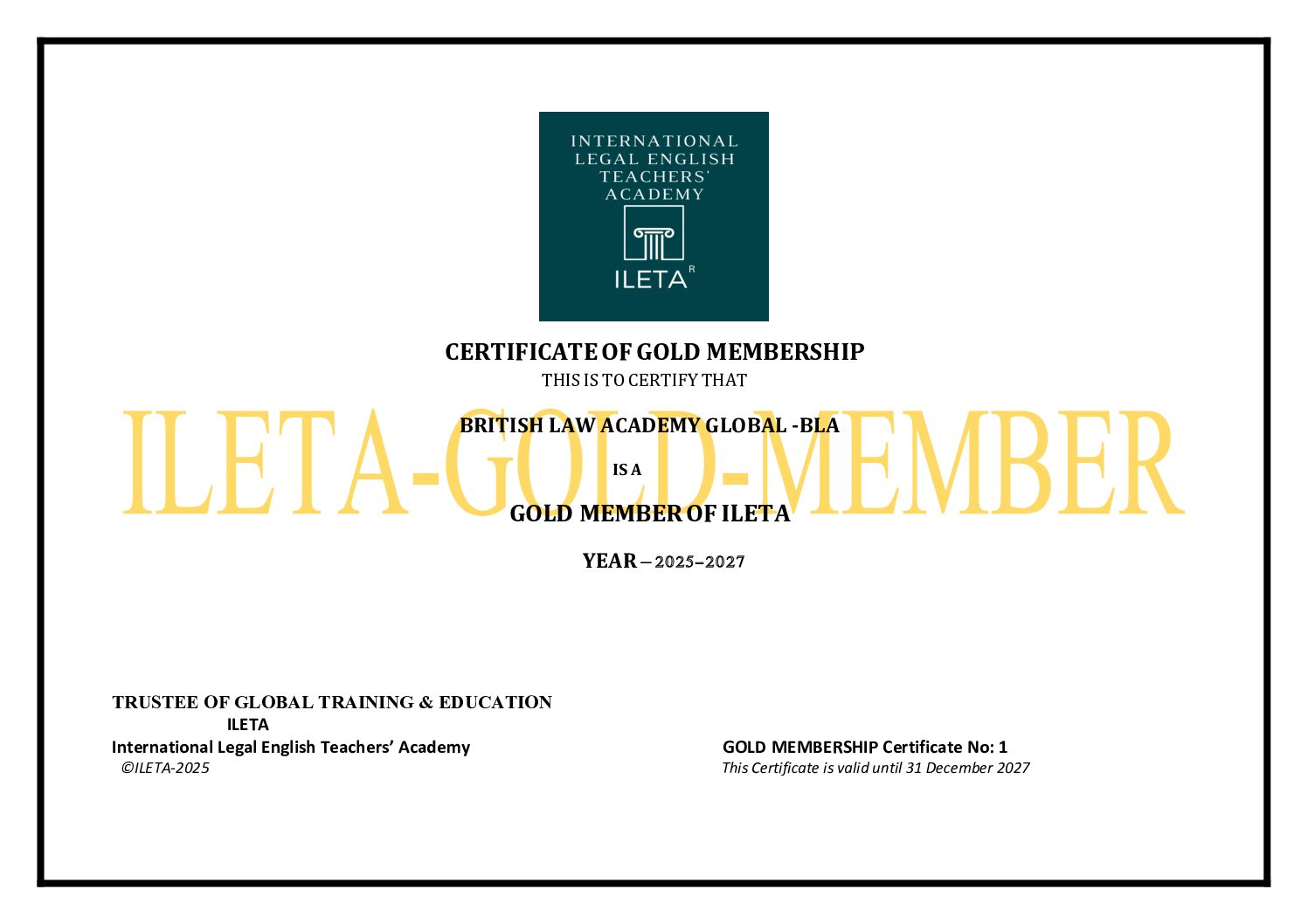
ILETA Welcomes the British Law Academy as a Gold Member
ILETA is pleased to announce that the British Law Academy has joined ILETA as a Gold Member.
This partnership reflects British Law Academy’s ongoing commitment to advancing excellence in Legal English education and to supporting both legal professionals and students in developing the language skills necessary to succeed in international legal practice.
As a Gold Member, the British Law Academy will play an active and pivotal role in ILETA’s mission of fostering collaboration, sharing resources, and promoting best practices among educators and institutions dedicated to education and Legal English worldwide.
ILETA warmly welcomes British Law Academy and looks forward to a productive collaboration that will contribute to the global development of Legal English teaching and learning.


In this pod episode, we look at the question: What is legal English? Presented by Sofia Parastatidou, practising solicitor, Founder of the British Law Academy, President of ILETA and author of Legal English (Pearson-2021).




I recently did an interview with Consens us legal magazine about the future of our profession and touched upon the role of AI. You can read the interview by following this link http://consenss.com/en/home/interview/10. What are your views on AI in the legal profession? Do you think we will all be replaced by artificial intelligence ?
In the meantime, thank you to Consens Us Legal Magazine.
Stay tuned for more surprises!
Sofia Parastatidou