 Our experienced tutors who are practising solicitors who are senior members of the profession are ready to help you pass your SQE and kick start your legal careers.
Need information ?
Email info (at) britishlawacademy (dot) com
Learn Legal English and Common Law

Our experienced tutors who are practising solicitors who are senior members of the profession are ready to help you pass your SQE and kick start your legal careers.
Need information ?
Email info (at) britishlawacademy (dot) com

The new SQE 1 structure will apply to all sitters from the January 2027 onwards. This includes resitters.
What main changes is the SRA introducing?
Reducing the number of questions
Each Functioning Legal Knowledge (FLK) assessment will be reduced from 180 to 170 questions.
As each FLK continues to be divided into two sessions per day, and candidates will now answer 85 questions per session, instead of 90 per session.
Thus, the total number of questions candidates answer in SQE1 overall will be 340, rather than 360.
2. To whom do these changes apply?
To candidates sitting in January 2027 and re-sitters.
3. What is the time allowed?
The time allowed remains unchanged at 2 hours 33 minutes per session. This means candidates will have slightly more time per question.
4. How will questions be grouped?
Another change is that subjects will now be grouped into specific sessions.
Questions in all subject areas will no longer be presented in both sessions of an FLK assessment. The questions in each FLK session will contain questions from the subject areas as shown in the table below:
FLK Session Subjects
FLK 1
Session 1
Session 2
FLK 2
Session 1
Session 2
NB: Ethics and Professional Conduct will however continue to be tested across all subject areas and can therefore be tested in each session.
Randomisation. Within each session, questions will continue to be fully randomised between those subject areas (i.e. candidates will not have all of the questions on one subject area presented together before the questions on another subject area are presented). This means that candidates will not receive questions grouped by subject areas; instead, questions covering the session’s different subject areas will appear in a mixed, random order throughout the sessions.
Reducing the number of questions
The SRA has made changes having listened carefully to candidate and stakeholder feedback. In particular, some candidates have told the SRA that the SQE1 assessment can feel rushed and pressurised in terms of the amount of time allowed to answer a question, and this can be exacerbated by the lack of some grouping of questions in the sessions.
The number of questions originally used in SQE1 assessments was carefully considered when developing the SQE. This recognised the need to sample all the subject areas in each FLK and have an assessment that was reliable. This means the assessment is consistently fair and accurate and a candidate’s score is a good and highly reproducible reflection of their ability.
The SRA is reducing the number of questions in SQE1 now following a data review from all previous SQE1 assessment windows. Making this change now, rather than after only a small number of deliveries, allows the SRA to review a sufficient amount of assessment data to provide confidence that reducing the number of questions will both improve the candidate experience and retain the accuracy of the assessment.
Grouping questions by session
For SQE1 assessments taken so far, all subject areas were assessed in both sessions of an FLK assessment. Some candidates have told the SRA that this has made it more challenging than it would otherwise have been. Dividing the subject areas for each FLK between the two sessions will allow candidates to focus on fewer subjects in each session. Retaining randomisation of questions within each session will help to preserve assessment security requirements.
The changes will first apply for the January 2027 SQE1. These will apply to all candidates – both first sitters and re-sitters.
Time allowed. Candidates will still be allowed 2 hours 33 minutes per session.
Blueprint. The proportion of questions that can be asked in each subject area (i.e. the SQE1 assessment blueprint) remains unaffected.


A Course Overview
The success of an internal domestic market depends on the validity of contracts supporting commercial relationships. Understanding how contracts are formed and operate are key to the success of every business.
Professionals advising businesses are asked to negotiate, prepare and advice on different types of contracts.
In the law of contracts, the Latin principle pacta sunt servanda is the starting point. This phrase means that agreements must be kept. Parties must perform their obligations and promises when they have binding contracts.
Under English common law, parties are generally allowed the freedom to enter any agreement they like. However, this freedom is not without restriction. Agreements must not be unlawful or is against public policy.
Valid contracts start with the essential elements, namely, the intention to enter into a contractual agreement, offer, acceptance and consideration. The question of how to protect a party once a valid and enforceable contract is breached is fundamental.
Professionals will need to assist their clients in deciding which remedies are best to protect the interests of their clients.
Domestic contracts are regulated by domestic courts. However, globalization has now added new dimensions to the domestic contract. Clients will need to know which courts have jurisdiction to hear and resolve their disputes even if their contracts are restricted to domestic relationships.
Commercial law governs both domestic and international commercial transactions. It covers areas of law such as contracts, torts, the sale of goods, marketing agreements, finance, credit arrangements, transportation, insurance, competition, intellectual property, tax law and customs.
When we deal with an international sale of goods, the considerations become even wider as we need to consider contract law, established customs and usage, national legislation of both the country of export and that of import, European law and international conventions.
An agreement for the international sale of goods involves goods being sold and shipped by sea, road, rail, or air to another destination in a different country. Both parties to the transaction will be taking steps to protect themselves against the risks involved in international trade such as risks in transport, financial risks, and force majeure.
There is no one size fits all and therefore to avoid or minimize risks, practitioners need to look at each case to determine the best risk management strategy for their particular clients. Effective drafting of clauses in agreements, insurance policies and secure cost-effective payment methods are just as important as choosing the best business model and partners.
Course Syllabus
Modules
Each module contains a study of essential vocabulary and legal elements, exercises, writing, drafting, case studies and role plays. Modules can be taken separately depending on their interest or professional needs. If participants complete all (6) modules, they will be awarded the Certificate of Completion.

Details
Total hours for the course = 12 hours
Mode: Online via ZOOM
Dates for Group 1 course: Saturday Morning from 10:00am – 13:00pm (Rome Time)
Dates for Group 2 Course: Saturday Morning from 10:00am – 13:00pm (Sydney Time)
ABOUT THE TRAINER: Sofia Parastatidou
Sofia is qualified practising solicitor of England and Wales where she has been admitted as a solicitor since 1997. She has also been admitted in Australia since 1991. Sofia has worked internationally training lawyers, accountants, in-house counsel and notaries. She teaches undergraduate law, masters courses and various post – graduate courses. Sofia is the President & Founder of ILETA (International Legal English Trainers’ Academy) and President and Founder of EUBETA (European Business English Teachers’ Association). She is the author of Legal English and trains lawyers who wish to re-qualify through the SQE to become solicitors in England and Wales. Sofia is the founder of Globelex International Lawyers.
Cost:
Group: Special Introductory Offer: €540 per person or AUD $899 per person
(NB: The course will be activated on a minimum 3 people, maximum 30)
Individual: One to One Private Lessons are quoted individually
Participants will be awarded a Certificate in International Commercial Transactions upon completion which can be added to their CV. Price also includes all didactic material.
For further details or to express an interest in this course send an email to: info(at)britishlawacademy (dot) com.
NB: As far as possible groups will be formed based English levels and professional experience.


How to Become a Successful International Lawyer
What does it take to build a successful career across borders?
Join our upcoming webinar and explore the essential skills, knowledge and mindset needed to succeed as an international lawyer in today’s global legal environment.
We will discuss:
Whether you are a law student, trainee, newly qualified lawyer or experienced legal professional looking to expand your international horizons, this webinar will offer practical insights and inspiration for your career journey.
Date: 2 October 2026
Time: 13:00-14:00 CET (Rome Time)
Online: Zoom
Registration Essential – Registration Form: How to become a successful international lawyer
Take your legal career beyond borders. Join us and discover how to become a successful international lawyer!
#InternationalLaw #InternationalLawyer #LegalCareer #LegalEnglish #Lawyers #CareerDevelopment #ProfessionalDevelopment #GlobalLaw #ComparativeLaw #LegalEducation #Webinar


The concept of subjective culture comes from Dr. Harry Triandis, a cross cultural psychologist, viewed culture as objective (also known as material) and subjective.
Subjective culture comprises ideas, attitudes and beliefs. An inter-culturist would focus primarily on subjective culture.
Material culture is man-made such as clothes and tools. On the other hand, subjective culture is the intangible part of culture such as ideas, attitudes, assumptions and beliefs. In other words, it is “a society’s characteristic way of perceiving its social environment”.
We can subdivide these further by taking either an ‘etic‘ or ‘emic‘ approach to studying the subjective elements.
“Etic” refers to the general categories. These elements can be found in all cultures and which we use to make comparisons.
“Emic” refers to elements which are specific to a given culture. This makes cultures unique.
Cultures have their own unique mix of beliefs, attitudes, norms and values.


 The British Law Academy (BLA) is excited to announce the launch of our services in Germany.
Our mission is simple: to support German legal professionals working across civil and common law jurisdictions by providing high-quality law courses and specialised Legal English training.
As cross-border work continues to grow, many German practitioners are engaging with lawyers from common law countries, such as England and Wales and Australia more frequently.. Understanding not just the language, but the legal concepts, structures, and culture behind it, is essential for German lawyers and their clients.
At the British Law Academy, our professional trainers who are also practising solicitors in England and Wales and Australia, will train you in:
• Practical law courses focused on key areas of common law
• Tailored Legal English programmes for lawyers and legal professionals
• Skills-based training designed for real-world international practice such as pre-trial negotiations, mediation, and litigation.
Whether you’re collaborating on international transactions, disputes, or advisory work, our courses run by expert lawyers with practical experience, are designed to give you clarity, confidence, and precision in your legal communication.
Join us today as we build a bridge between common law and civil law legal systems.
PRESS RELEASE
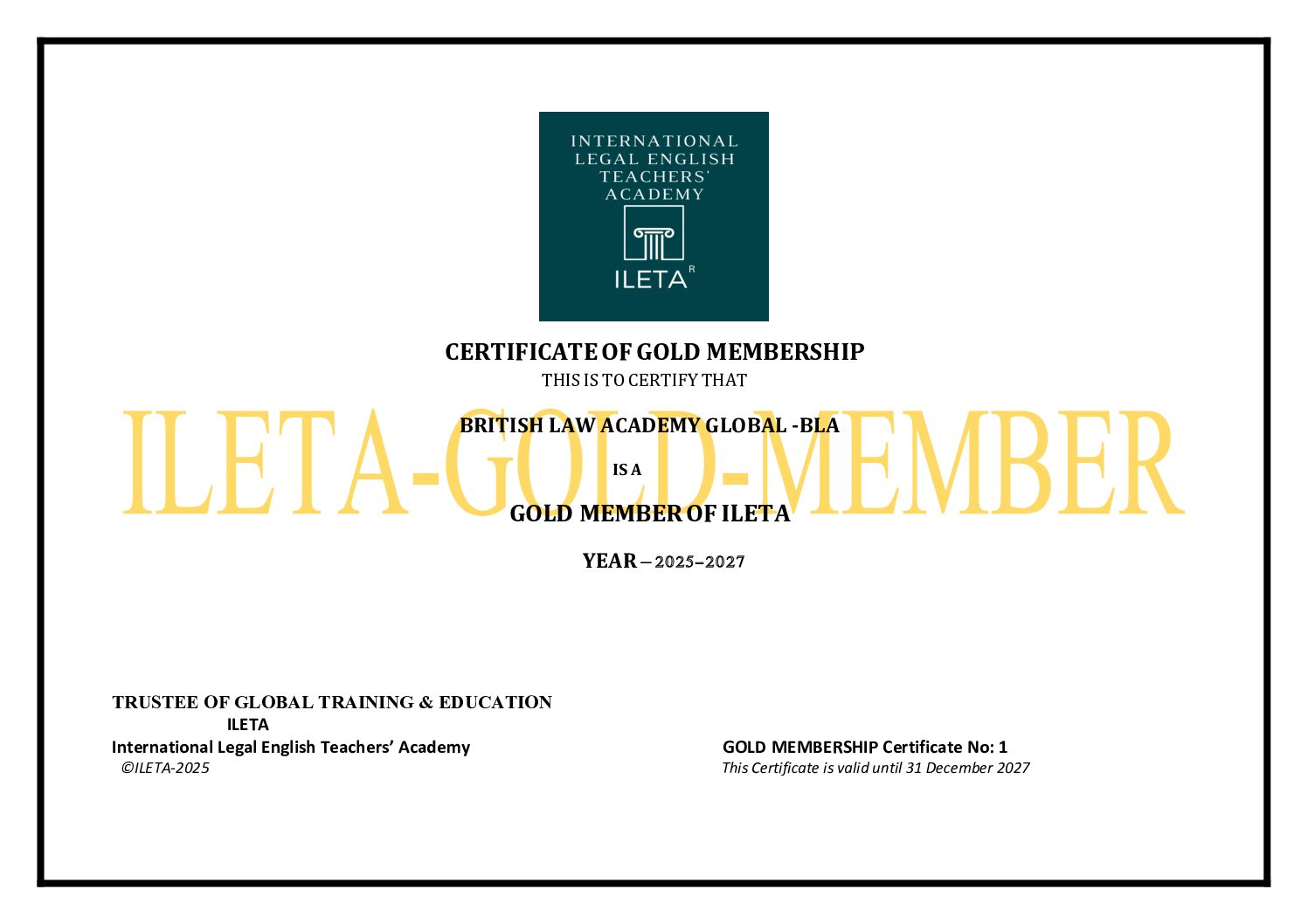
ILETA Welcomes the British Law Academy as a Gold Member
ILETA is pleased to announce that the British Law Academy has joined ILETA as a Gold Member.
This partnership reflects British Law Academy’s ongoing commitment to advancing excellence in Legal English education and to supporting both legal professionals and students in developing the language skills necessary to succeed in international legal practice.
As a Gold Member, the British Law Academy will play an active and pivotal role in ILETA’s mission of fostering collaboration, sharing resources, and promoting best practices among educators and institutions dedicated to education and Legal English worldwide.
ILETA warmly welcomes British Law Academy and looks forward to a productive collaboration that will contribute to the global development of Legal English teaching and learning.


 The SQE (Solicitors’ Qualifying Exam) is the blueprint way to re-qualify as a solicitor in England and Wales. The SQE 2 is the second exam which must be taken after candidates have successfully passed the SQE1.
What does the SQE2 involve? In this podCast, Sofia Parastatidou – Solicitor of England & Wales, and President of ILETA explains what is involved and tested in the SQE2 exam.
Sofia is an experienced SQE trainer and offers training courses on a 1:1 basis or as a group courses through the British Law Academy. Listen to the podCast below and start your SQE journey today.


In this PodCast, Sofia Parastatidou, Special Counsel and President of ILETA explores the question ‘What is Legalese?’.
‘To be an effective legal communicator, you will need to use Plain English and Legalese in a manner that makes your legal writing effective. ‘ says Sofia Parastatidou.

In this podCast, Sofia Parastatidou, Special Counsel and President of ILETA explains why Legal English is important in today’s world.

In this pod episode, we look at the question: What is legal English? Presented by Sofia Parastatidou, practising solicitor, Founder of the British Law Academy, President of ILETA and author of Legal English (Pearson-2021).


Need private tuition to help you pass your CILEX exams.
No problem! Our decade long experience in private tutoring lawyers around the world to qualify in the UK is our legacy. Now let us help you start the path to the new career you have been waiting for.
Contact us today by emailing info@britishlawacademy.com and we will set up a meeting for you with one of our CILEX experts.


Hello to you all,
My name is Sofia and I am a practising UK Solicitor. I am also a professional trainer and author.
Much has changed in our world since I was first admitted as a lawyer in 1991. My studies and my initial work experience, concentrated on learning and applying national law. International law was considered more of an academic curiosity than a pragmatic and necessary tool of trade.
Over the years, international economic trade extrapolated national boundaries, culminating in a globalised world for the sale of goods and the provision of services. This has had an ever-evolving impact on the role of all advisers. By the 1990s, we were truly well on our way to having international markets and inevitably, international professions.
The Covid pandemic of 2020 infected the globe as a whole. The impact was instantaneous and simultaneous. Global business came to a standstill.
Changes were also dawning on the horizon of the European Union. The United Kingdom held a referendum which culminated in Brexit. What impact Brexit will have is still unclear.
The question of whether other European nations will follow, thus causing the disintegration of the European Union, remains to be seen. And whilst it is true – there is much uncertainty in our lives – there is a constant. The attractiveness of common law.
In fact, many commercial parties find England and Wales a very attractive jurisdiction for dispute resolution and often adopt English law as the governing law in their international commercial agreements. This is even so when neither of the parties are British.
It therefore follows, that legal education must also move with the times and respond to the needs of the market. Communicating accurately and effectively with impact can only be achieved if a practitioner possesses solid knowledge, not only of their own domestic legal system, but the counterpart’s legal system. It is often the case, that foreign law is more attractive than one’s own domestic law, and therefore more conducive to the parties’ ultimate commercial aims.
Translating, working, negotiating or resolving problems where commercial consequences hinge on the outcome is particularly challenging if done in a language which is not your native tongue.
English is the lingua franca. It is the official global working language, and many professionals deal with and advise English speaking clients, communicate with colleagues across borders, and negotiate with foreign counterparts. Today, this is the norm rather than the exception in business.
And so, this brings me to my text – Legal English. As you all know, Legal English is not English. Professional Legal English is characterised by long sentences, often written in the passive voice, containing technical and/or Latin terms. And whilst this language is considered archaic and impractical from a commercial or practical point of view, it is worth remembering that Judges will be using this archaic language when resolving disputes, through the application of leading case law precedents. Alternatively, clients expect and demand cost effective solutions to their problems or when negotiating transactions. Clear, effective and high impact language is imperative.
My aim when writing Legal English was to provide our readers with a useful, easy-to-read manual – an outline of essential core legal concepts. I have chosen ten main areas of law, including contracts, torts, intellectual property, criminal law, international commercial transactions, commercial litigation and alternative dispute resolution. Each unit contains four lessons which cover different aspects of the core topics. Each unit also comes with language skills, such as exercises, listenings, pronunciation and writing corners.
As case law is the very heart of common law, I have included ten precedent making or notorious case studies to illustrate their impact on the development of common law. Each exercise has its own answer key, to assist you in verifying your understanding, application and critical analysis of legal concepts.
Finally, in the Annexures part of our textbook, the reader will find a number of Official Forms and Model Agreements. This aim here is to illustrate how concepts discussed in the units are applied to real life professional scenarios and to bridge the gap between theory and practice.
Whatever your professional background – law, accounting, or linguistics, or whether you are an in-house counsel, notary, accountant or translator, I hope this book becomes an invaluable resource in your professional libraries.
And finally, for our future professionals. Your market is changing rapidly. The pressure on future professionals will be even greater than today as business transactions become more and more complex. For your success, being highly skilled and knowledgeable as well as being in possession of a wide range of hard and soft skills, will be imperative. Knowledge of differing legal systems and a solid command and understanding of Legal English will be essential.
I sincerely hope you enjoy your world-wind tour of common law, and that you find the reading enticing enough to stop off and take a more in-depth tour of all the sightseeing trips we have included for you in each of our Legal English units.
Truly honoured to welcome you to our new adventure through podcasting.
Podcast Channel : https://anchor.fm/britishlawacademy